50+ Best German Christmas Market Foods You Need to Try (with FREE Checklist)

If there’s one thing that can compete with the festive lights and awesome atmosphere of a German Christmas market, it’s the incredible food.
From savoury sausages sizzling on the grill to sweet treats dusted with sugar, the variety is endless.
And if you need to know anything about us, it’s that we love food almost as much as we love to travel!
Whether you’re strolling through the market with a warm cup of Glühwein or devouring a plate of crispy Kartoffelpuffer, the flavours of a German Christmas market are unforgettable.
Ready to find out which foods you absolutely need to try? Let’s take a bite out of the best dishes these festive markets have to offer!
Best German Christmas Market Foods You Just Have to Try
After spending an entire month in Germany exploring the many Christmas Markets, I can comfortably say that we have tasted most of the foods offered at the markets.
And while some of them were huge hits, others were given a thumbs-down by the kids, or even the adults in our group.
We have chosen to break up our list of foods into three categories – sweet, savoury, and festive drinks – to make things a little easier.
Sweet Treats
I definitely have a sweet tooth, so the treats were my favourite to try. But rest assured, I didn’t get many complaints from the rest of the family when I wanted to try something new!
1. Lebkuchen
I absolutely love Lebkuchen.
Lebkuchen is the German version of gingerbread, often spiced with cinnamon, cloves, and nutmeg.
Originating in Nuremberg, they’ve been a Christmas staple for centuries, with recipes dating back to the 13th century.

The heart-shaped Lebkuchen decorated with icing and inscriptions are a staple at nearly every German Christmas market.
You will often see it hanging in the stalls as part of the seasonal decor.

The version is harder than the smaller cookies, and the icing makes it much sweeter.
I am not a fan of this type of Lebkuchen.
2. Elisenlebkuchen
Elisenlebkuchen is a premium type of Lebkuchen, known for its high nut content and minimal flour, making it softer and more flavorful.
These are what I crave while in Germany!

Originating in Nuremberg, these cookies must contain at least 25% nuts, usually almonds or hazelnuts, and are often topped with a thin layer of chocolate or icing.
I actually didn’t know that Elisenlebkuchen is a protected specialty in Germany.
So if you see these yummy treats at a Christmas market, you’re tasting a piece of true German tradition.
3. Stollen
Stollen is a traditional German dessert most commonly made during the Christmas season.
It has been baked in Dresden since the 15th century and is recognized worldwide.
This dessert is a dense and rich fruit bread made from a sweet, buttery yeast dough.

Stollen is typically spiced or lemon-flavoured and includes a mix of dried fruits, nuts, and marzipan.
The bread is usually shaped into an oblong loaf and finished with a coating of butter and powdered sugar.
🎄 Fun Fact: Only Christstollen baked by certified bakers in Dresden can be labelled as Dresdner Christstollen.
4. Schneeballen
Schneeballen, or “snowballs,” are crunchy, round pastries traditionally from Rothenburg ob der Tauber.
They date back over 300 years and were originally served only at weddings.
Made from strips of shortcrust pastry dough, they’re shaped into a ball, deep-fried, and then dusted with powdered sugar, which makes them look like snowballs.

Today, you can find Schneeballen in a range of flavours, including chocolate, caramel, and even ones filled with marzipan.
These treats have become pretty popular. We were actually surprised when we spotted them in Christmas Markets outside of Rothenburg.
A word of advice – they are extremely messy to eat!
5. Gebrannte Mandeln
Gebrannte Mandeln, or roasted almonds, are a pretty popular snack at German Christmas markets, and one of my favourites.
These almonds are coated in a mixture of sugar, vanilla, and cinnamon, and then roasted until they’re perfectly caramelized.
Along with roasted almonds, most stands will also sell roasted peanuts, walnuts, cashews, pistachios and hazelnuts. Many will offer a mixed bag, which is what I usually go for.

They give off a sweet, warm aroma that fills the air as you wander through the market. And it pulls me in EVERY TIME!
This treat dates back to the 17th century when vendors sold them at fairs and festivals.
Today, they’re a holiday favourite, often served in paper cones. You’ll find them in different flavours, too, like chocolate or even chilli for a bit of a kick.
6. Baumstriezel
Baumstriezel, also known as chimney cake, is a delicious pastry with roots in Hungary and Romania. But it has become popular in German Christmas markets, too.
Made from a sweet yeast dough, it’s rolled onto a wooden cylinder and then grilled over an open flame.

The pastry is hollow in the middle, which is why it’s nicknamed “chimney cake.”
As it cooks, it’s brushed with butter and sprinkled with sugar, which caramelizes to give it a crispy, golden crust.

Traditionally, Baumstriezel is dusted with cinnamon, but you’ll often find varieties coated in chocolate, nuts, or even coconut.
I definitely lean towards the traditional on this treat. I prefer my Baumstriezel just dusted with sugar and cinnamon.
7. Germknödel (or Dampfnudel)
Germknödel is a traditional German dessert consisting of a large steamed dumpling.
It’s especially popular in southern regions like Bavaria.
The dumplings are made from a soft, sweet yeast dough that becomes light and fluffy as it steams.

After steaming, they’re typically drizzled with a warm vanilla sauce that soaks into the dumpling, and then topped with either cinnamon or ground poppy seeds, or both.
While exploring the Christmas markets, we noticed many vendors offering Germknödel filled with fruit compote.

We tried plum, cherry, and raspberry versions, though I avoided the apple-filled ones due to an allergy.
They quickly became my go-to Market treat! My favourites were the ones I found in Frankfurt’s Römerburg Market.
8. Schaumkuss or Schokokuss
Schaumkuss, or Schokokuss, are treats made with a fluffy marshmallow-like filling on a crispy wafer base, all coated in chocolate.
Depending on the market, you can find Schaumkuss in a variety of flavours, including vanilla, strawberry, chocolate mint, or even Oreo.

My favourite was an Eierlikor-flavoured Schaumkuss that we found in Nuremberg.
It was my first ever taste of this treat, and unfortunately, none of the others I tried came close to being as yummy as this one!

Not that we didn’t try, and enjoy, quite a few!
9. Marzipan
Marzipan is a sweet almond paste that you will find shaped into festive figures or dipped in chocolate.
It’s another favourite of mine.

It’s made from finely ground almonds and sugar, giving it a smooth, chewy texture that’s both rich and subtly nutty.
Aside from being sold on its own, marzipan is also commonly found in stollen, marzipan loaves, and chocolates, where it’s sometimes used as a filling.

Even Ritter Sport has a special Marzipan bar that comes out around Christmas!
10. Schoko-Obst or Schoko-Früchte
Schoko-Obst, or chocolate-covered fruit, is something you will find in almost every market.

Popular options include strawberries, bananas, grapes, kiwi, orange slices, and apple slices, all skewered and dipped in rich, melted chocolate.
Some stalls offer choices like white chocolate or even toppings like sprinkles and nuts.

Schoko-Obst was one of my daughter’s favourites. And while they were all quite good, I did not find them unique enough to binge on!
11. Quarkbällchen
Quarkbällchen are small, round doughnut-like treats that are very similar to Italian Sfingi.
These were a big hit with our kids at the Christmas market. Trust me when I tell you, that they put our Canadian Timbits to shame!

Quarkbällchen are made from a dough that includes quark, a type of fresh cheese similar to cottage cheese but smoother and creamier.
The dough is then shaped into small balls and deep-fried until golden brown, creating a crispy exterior with a soft and fluffy inside.

After frying, they’re often rolled in sugar while still warm, giving them a sweet, crunchy coating.
They are absolutely heavenly!
12. Zimtsterne
Zimtsterne, or “cinnamon stars,” are classic German Christmas cookies made from ground almonds, sugar, and cinnamon, topped with a crisp white icing.
These star-shaped cookies have a chewy texture and a warm, spiced flavour that I really enjoy.

Originating in the Swabian region (which is where my family is from), Zimtsterne are gluten-free and often enjoyed with a cup of hot mulled wine or tea at Christmas markets.
13. Crêpes & Waffeln
Crepes are thin pancakes filled with anything from Nutella and bananas to cinnamon and sugar.
And just like in North America, German waffles are fluffy and often topped with whipped cream, berries, or a dusting of powdered sugar.

Both are served hot, with plenty of options for sweet or savoury toppings.
Our youngest was a huge fan of Nutella crepes. He LOVED the metre-long crepes we found in the Heidelberg Christmas Market.
14. Bauernkrapfen
Bauernkrapfen are a traditional Austrian and Bavarian pastry, similar to a donut but flatter and larger.
Made from yeast dough, they’re deep-fried until golden, with the center often left thin and crispy while the edges are soft and fluffy.

At Christmas markets, you’ll find them topped with powdered sugar, jam, or sometimes even a dollop of creamy custard.
John and the kids loved the custard-filled ones, while they were a tad heavy for my liking.
15. Paradiesäpfel
Paradiesäpfel, or candied apples, can be found in most markets. However, they may not always be the same.

We found many of the iconic bright red apples, coated in a hard, glossy sugar shell.
But we also found apples dipped in chocolate, or covered in a variety of candy like gummies or Skittles.

Since I am allergic to apples, they are not my thing!
16. Linzeraugen
Linzeraugen, also called Linzer cookies, are delicate sandwich cookies filled with fruity jam, typically raspberry or red currant.

They’re made with a buttery, almond-based dough and have small cut-out shapes on the top cookie, revealing the jam inside.
Originating from Austria, Linzeraugen are dusted with powdered sugar and are a popular, festive treat at Christmas markets throughout Germany and beyond.

My family loves these cookies, and we would often pick up some to take back to our rental as an after-dinner treat.
17. Schmalzkuchen or Mutzen
Schmalzkuchen are small, bite-sized donuts made from sweet yeast dough.
These little treats are deep-fried until golden, dusted generously with powdered sugar, and then served hot in paper cones.

Schmalzkuchen are perfect for sharing, which is how the kids managed to sucker us into buying them as often as we did!
18. Apfelstrudel
Apfelstrudel is a classic dessert with layers of thin, flaky pastry wrapped around a filling of spiced apples, raisins, and sometimes nuts.
Originally from Austria, it’s become a popular treat at German Christmas markets.

While Apfelstrudel comes in a variety of shapes and sizes, it is usually served warm with a dusting of powdered sugar.
Once again, due to an allergy, I usually opted for a different flavoured strudel (cherry is my fave), which was just as good.
19. Kaiserschmarm
Kaiserschmarrn is a fluffy, shredded pancake traditionally from Austria, but it’s often found at German Christmas markets too.
Made with a light batter, it’s cooked until golden, then torn into pieces and caramelized with sugar.

Served warm, it usually comes with a side of apple sauce or plum compote. The version we tried was covered in a blackberry sauce and was deee-lish!
20. Sweet Pretzels
What is more German than a pretzel?
Sweet pretzels are a tasty twist on the classic and are popular at German Christmas markets.

These soft, doughy treats are typically coated in cinnamon sugar or drizzled with chocolate for an extra touch of sweetness.
Some even come filled with Nutella or vanilla cream. The varieties are endless.
Again, I would say that I lean towards the traditional when it comes to Pretzels. I prefer mine to be savoury.
Savoury Foods
These savoury foods range from a quick snack to a full-on hearty meal. There are also vegetarian options included.
21. Brezeln
Brezeln, or pretzels, are an iconic snack you’ll find at every German Christmas market.
These baked treats have a distinctive knot shape, a crispy golden-brown crust, and a soft, chewy center.

While traditional pretzels are sprinkled with coarse salt, you can also find varieties topped with melted cheese, seeds, or even a hint of garlic butter for extra flavour.
I love mine cut in half and slathered with butter.
22. Bratwurst
Bratwurst is a classic German sausage that’s a must-try at any Christmas market.

They are served grilled to perfection, usually in a crusty roll with mustard or sauerkraut on top.
You’ll find various types, from the traditional pork bratwurst to regional specialties like the smoky Thüringer, providing you with plenty of options.

I think the boys tried several versions during our trip, for comparison’s sake. Ha!
23. Kartoffelpuffer or Reibekuchen
Made from grated potatoes mixed with onions and a touch of flour, they’re fried until golden brown.

Kartoffelpuffer are traditionally served with a side of applesauce or sour cream.
We tried several variations while exploring the Christmas markets, and our favourite topping was Frankfurt’s iconic green sauce.

Trust me, you can’t leave Frankfurt without trying it! It was definitely a favourite of the kids.
24. Schupfnudeln
Schupfnudeln are German noodles made from potatoes, flour, and eggs.
They’re hand-shaped into small, finger-like dumplings, then boiled and pan-fried until crispy on the outside.

To me, they’re very similar to Italian gnocchi, just much larger.
Schupfnudeln are often served with sauerkraut and bacon, and it’s unbelievably tasty!
Even the kids devoured this dish!

I’ve heard that Schupfnudeln can also be served as a sweet dish, but I haven’t come across it yet.
Apparently, the sweet version is tossed with sugar and cinnamon and might be paired with apple sauce or a fruity compote.
🍲 Fun Fact: The name “Schupfnudeln” comes from the German word “schupfen,” meaning to shove. This describes how the noodles are shaped
25. Flammkuchen
Flammkuchen is essentially a mix between flatbread and pizza.
The dough is rolled out thinly into a rectangular shape and is usually topped with crème fraîche, thinly sliced onions, and strips of fatty bacon.

The name Flammkuchen, meaning “Flame Cake,” comes from it being baked in a wood-fired oven.
We tried this yummy treat in several markets, and they were all delicious.
26. Soup in Bread Bowl
This is exactly what it sounds like – soup served in a bread bowl!
The soup, often something like a creamy potato, pumpkin (what I tried), goulash, or tomato, is ladled into a hollowed-out round bread loaf, which absorbs the flavours as you eat.

While we didn’t see it in too many markets, it was definitely a great way to warm up on a chilly day!
Of course, the best part is, that once the soup is gone, you can eat the softened bread bowl. Two treats in one!
27. Raclette
Raclette is a popular savoury treat involving melted Swiss cheese scraped over potatoes, bread, or even croissants.
The cheese is warmed and softened until bubbly, then generously spread over your bread. Complete deliciousness!

While traditionally from Switzerland, raclette has become a favourite in German markets as well.
You will have no problem finding at least a couple of stalls selling this gooey treat in any market that you visit.
28. Currywurst
Currywurst is one of Germany’s most iconic street foods, and it’s a dish that Berlin is particularly famous for.
It is also especially popular in Christmas markets.

Currywurst consists of a grilled sausage smothered in a special curry-flavoured ketchup and sprinkled with curry powder.
You may find it served up on its own, or with a side of fries or a crusty roll.

While we enjoyed the flavour, I still don’t quite get the obsession with currywurst.
29. Handbrot
Handbrot, or “hand bread,” was a surprise favourite for the boys and me.

It is basically a bread roll that’s stuffed with cheese and ham, or mushrooms and cheese, then baked until the cheese melts and the bread has a golden crust.
It’s then topped with a dollop of sour cream and chives.

Judging by the lines, handbrot is pretty popular in the markets. Not surprising given just how delicious it was!
Our favourite version was the one we tried in the Augustus Market in Dresden.
30. Stuffed Baked Potato
Stuffed baked potatoes were not something I expected to find in a German Christmas Market!
Yet, they were everywhere!

And they are exactly what you would expect. A large baked potato stuffed with a variety of different fillings.
Some of the common fillings we noticed were sour cream, cheese, chives, bacon or even smoked salmon.
31. Arancini
John was very surprised to see Arancini in the markets.
These Italian rice balls are commonly found in Sicily (and throughout Italy) but were something totally unexpected in a German Christmas market.

These golden, breaded balls are made from risotto rice, typically filled with cheese, meat, or vegetables, and then deep-fried for a crispy outer layer.
They are quite delicious and reminded me of the ones my Nana Mary would make.

We also found a couple of stands that also sold sweet Arancini. These were filled with chocolate or custard and were also quite tasty.
32. Frikadella
Frikadella, also known as German meat patties, are a savoury snack you can find at many Christmas markets.
Basically a hamburger, they are made from a mixture of ground meat, typically pork or beef.

They’re seasoned with herbs, onions, and spices, then pan-fried until golden.
Frikadella are served in a roll or with a side of mustard and are definitely satisfying on a chilly day in the market.
33. Semmelknödel
Semmelknödel are traditional German bread dumplings made from day-old bread, eggs, milk, and seasonings.
I absolutely LOVE dumplings! So I was pretty stoked when I found out that these were a popular treat in the markets.

These dumplings are typically served as a side dish, often accompanying hearty dishes like roast pork or mushroom sauce.
But at the Christmas markets, Semmelknödel are the main show, usually topped with a rich gravy or sauce.

My favourites were the ones I found in the Medieval Market in Esslingen. My mouth is watering just THINKING of them!
34. Lángos
Lángos is a popular Hungarian snack that has made its way to some German Christmas markets.
This deep-fried flatbread is crispy on the outside and soft on the inside.

Lángos are typically topped with garlic butter, sour cream, and grated cheese, but you’ll also find variations depending on the market you are in.
We even noticed a few places that offered a sweet version with toppings like powdered sugar or Nutella.
35. Käsespätzle
Käsespätzle is a German comfort food dish made from soft egg noodles layered with melted cheese and topped with crispy fried onions.
Often described as the German answer to mac and cheese, it’s rich, creamy, and full of flavour.

This is, not surprisingly, my kids’ favourite dish!
While I grew up with homemade spätzle served with lentils, my kids tend to favour the cheese topping.
Either way, you really can’t go wrong with Spätzle!
36. Champignons
Champignons, or sautéed mushrooms, are a popular treat at German Christmas markets.
These mushrooms are typically cooked in a large skillet with garlic, herbs, and sometimes a splash of white wine for extra flavour.

They’re often served with a dollop of garlic sauce or a sprinkle of fresh parsley.
And can I tell you how absolutely WONDERFUL they smell while cooking?!
Much like the candied almonds, the smell sucks me in every time!
My kids have a hard aversion to mushrooms, so this item was a no-go with them.
37. Pommes
Pommes, or French fries, may not be a showstopper in the markets, but they are delicious!
We were definitely surprised while walking through the market in Stuttgart, that we came across a Canadian stall selling POUTINE!

And seeing John’s Canada toque, we were cheered and beckoned over.
The stall sold a variety of poutine options that smelled heavenly.
Of course, in other markets, we also noticed pommes being sold with just traditional dipping sauces like ketchup, mayonnaise, or even curry sauce.
38. Flammlachs
Flammlachs, or flame-grilled salmon, is a popular specialty at German Christmas markets.
This dish involves fresh salmon fillets that are mounted on wooden boards and grilled over an open flame, giving the fish a smoky, tender flavour.

Flammlachs is usually served in a roll with a light herb or dill sauce, or just on its own.
I love salmon and opted for the roll. It was really tasty, especially with the dill sauce.
39. Kartoffellanzen or Spiralkartoffeln
Kartoffellanzen, or potato tornados as we call them in Canada, are basically spiral-cut potatoes on a stick.
The thinly sliced potatoes are spiralled onto a stick, and then fried until crispy and golden.

They’re usually seasoned with salt, paprika, or other spices, making them a flavorful, easy-to-eat snack that’s perfect for strolling through the market.
My son loves them and couldn’t wait to get his hands on a couple. He was not disappointed!
40. Steckerlfisch
Steckerlfisch is a traditional Bavarian dish featuring fish, typically trout or mackerel, skewered on a stick and grilled over an open flame.
The fish is marinated with herbs and spices, giving it a smoky, flavorful crust while staying tender inside.

Full disclosure, while we all enjoy a variety of fish dishes, we did not try these.
It was a no-go for all family members as they did NOT look delicious! Lol.
41. Spießbraten
Spießbraten is a hearty German dish made from marinated pork or beef, skewered and slow-roasted over an open flame.
The meat is typically seasoned with garlic, onions, and a blend of spices, creating a flavourful and juicy result.

In Frankfurt, we found the Spießbraten served on a skewer with a roll. My mom absolutely devoured hers!
I am also allergic to pork, so I stayed away from this delicious-smelling treat.
42. Knoblauchbrot
Knoblauchbrot, or garlic bread, is exactly what you would expect.
It’s crusty bread slices brushed with garlic butter and herbs then toasted until golden and fragrant.

While most markets offer Knoblauchbrot as the main dish, we are more likely to have it as an accompaniment to a meat dish.
43. Maroni
Maroni, or roasted chestnuts, are a classic winter snack found at Christmas markets throughout Germany.
These chestnuts are roasted over an open flame until their shells split, revealing a warm, tender, and slightly sweet interior.

Served in paper cones, Maroni are definitely a traditional and nostalgic treat.
I loved that most markets had an oven that looked like an old steam engine train where the maroni were roasted.
Festive Drinks
While I usually don’t drink very much, I do have a soft spot for sipping on Glühwein while walking through the markets. Besides… there are plenty of non-alcoholic options AND I was collecting the mugs!
44. Glühwein
During the Christmas season, Glühwein is a mulled wine that can be found in Christmas markets all over Germany.
It’s usually made with red wine and infused with spices like anise, cinnamon, cloves, and citrus zest from oranges and lemons. The mixture is served hot, similar to apple cider.

While visiting the Christmas markets, I made sure to sample both the red and white varieties, and they were both delicious.
My fave was the white wine, especially the one I tried in Rothenburg ob der Tauber’s Reiterlesmarkt.
45. Fruit Glühwein
Fruit Glühwein is a twist on the traditional German mulled wine, made by adding fruit flavours like apple, cherry, or berry to the classic spiced red wine base.

Just like regular Glühwein, the fruit version is also infused with ingredients like cinnamon, cloves, and citrus, giving it a rich, aromatic flavour.
We tried a few variations, but my favourite was always the cherry Glühwein.
46. Kinderpunsch
Kinderpunsch is a non-alcoholic mulled drink commonly found at German Christmas markets.
It’s perfect for kids and those avoiding alcohol. Our kids really liked it.
Kinderpunsch is made by heating fruit juices like apple, cherry, or grape with warm spices such as cinnamon, cloves, and star anise, creating a delicious and aromatic beverage.
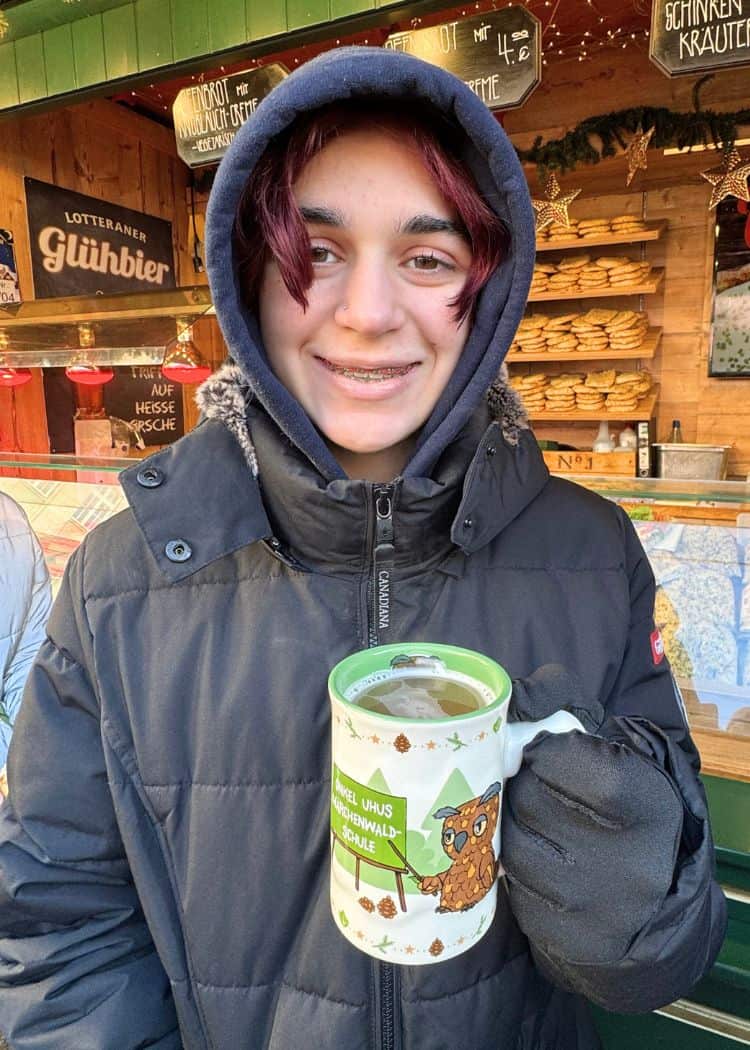
While often sweetened with a touch of honey or sugar, I never found the Kinderpunsch to be too sweet.
While visiting the Leipzig Christmas Market, we even found a special kid’s version of their Glüwein mugs. Of course, we bought it!
47. Feuerzangenbowle
Feuerzangenbowle is a unique German drink that you will find in almost every Christmas Market.
Feuerzangenbowle starts off with citrus-heavy Glühwein. A rum-soaked sugar cone, called a Zuckerhut, is then set on fire above the pot, melting the sugar into the spiced wine below.

This process adds a delicious, caramelized flavour to the drink.
While definitely popular, there weren’t many markets that actually handed you the cup with the sugar cube on fire. The exception we came across was the Augustus Market in Dresden.

You mostly came across a large cauldron of Feuerzangenbowle with the giant sugar cube on fire. Your drink would then be drawn from that cauldron.
It was definitely delicious.
48. Eierlikör
Eierlikör is a traditional German liqueur made from egg yolks, sugar, vanilla, and brandy.
It’s thick, creamy, and has a rich yellow colour.
While it’s often compared to North American eggnog, I find it to be quite different.
For starters, it’s alcohol-based, and the texture is much thicker.

Eierlikör is especially popular during the holiday season and is often served in small chocolate cups.
The best Eierlikör that I sampled (and bought) was from Wagner’s Honighaus in Frankfurt. It was mixed with honey and was to die for!
49. Eierpunsch
Eierpunsch is a warm, spiced egg-based drink similar to eggnog.
Made with egg yolks, sugar, white wine, rum, and holiday spices like cinnamon and cloves, it has a creamy texture and a rich flavour.

You will find it in most markets topped with a healthy serving of whipped cream.
Eierpunsch was definitely another favourite of mine.
50. Apfelwein
Apfelwein, or apple wine, is a popular drink in Germany, especially in the Hesse region.
It’s a tart, fermented apple cider with a slightly sour taste, often enjoyed warm during the colder months.

At Christmas markets, Apfelwein is sometimes spiced and served hot, similar to mulled wine.
My mom and John gave this one a try (me and my food allergies had to pass), and they found it ok. John found it to be a little too tart.
51. Heißer Apfelsaft
Heißer Apfelsaft, or hot apple juice, is a popular non-alcoholic drink at German Christmas markets.

The apple juice is warmed and spiced with cinnamon, cloves, and sometimes a hint of orange, creating a comforting, cider-like flavour.
The kids gave this one a try and it was a thumbs up from both.
52. Heißer Schokolade
Heißer Schokolade, or hot chocolate, is a classic treat at German Christmas markets.
Loved by both kids and adults, it’s made with rich, melted chocolate or cocoa powder and steamed milk.

While most stalls serve the hot chocolate with whipped cream, I also noticed some places offering marshmallows, or even a dash of cinnamon.
The German Hot Chocolate was given a thumbs up from all but my mom, who does not like chocolate (really!).
53. Lumumba
I had never heard of Lumumba before visiting the German Christmas Markets.
Lumumba combines hot chocolate with a shot of rum, giving it a rich, creamy taste with a hint of warmth from the alcohol.

Topped with whipped cream, Lumumba is delicious and definitely an indulgent treat for adults.
I most certainly sampled a few of these… you know… for comparison’s sake!
54. Glögi
Glögi is a traditional Nordic mulled drink popular in Finland.
We noticed that you could find it in any Finnish-themed areas in German Christmas markets.

Made with red wine or fruit juice, it’s spiced with flavours like cinnamon, cardamom, cloves, and ginger, giving it a warm, cozy taste.
Traditionally, Glögi is served with raisins and slivered almonds added to the cup.
55. Glühbier
Glühbier is made by heating a dark beer and adding holiday spices like cinnamon, cloves, and star anise.
This warm beer-based beverage has a rich, malty flavour with a subtle hint of sweetness from the added fruit and spices.

John really liked it. He said that while drinking warm beer was a little strange, the flavour was pretty unique.
We only found Glühbier at some Christmas markets.
56. Jagertee
Jagertee is a warm, spiced alcoholic drink. While it originates from Austria, it is often enjoyed at Christmas markets in Germany as well.

It’s made by combining black tea with a mix of rum, red wine, and spices like cinnamon and cloves, resulting in a strong and flavorful beverage.
John was not too impressed with this holiday beverage, and I was definitely NOT a fan. I found it way too strong!
57. Grog
Grog is a traditional hot drink made by mixing rum with hot water, sugar, and a squeeze of lemon.
It has a light, citrusy flavour that is balanced by the sweetness and warmth of the rum.

We found it available in most Christmas Markets in Germany.
While Grog is especially popular to help beat the winter chill, it was not very good (at least in my opinion).
58. Honey Mead
Honey mead, or Met in German, is an ancient fermented drink made from honey, water, and yeast.
It is enjoyed for its sweet and slightly floral taste. It was actually pretty nice tasting.

Honey mead can also be found in spiced versions with additions like cinnamon or cloves.
We only found mead in markets that had a medieval-themed area.
59. Schneewittchen
Schneewittchen (meaning Snow White) was my hands-down favourite drink that I tried during our whole tour of German Christmas Markets.
This drink combines red Glühwein with white chocolate liqueur, creating a pinkish-coloured drink, that is then topped with whipped cream.

This warm, sweet treat offers a delicious twist on traditional Glüehwein and was definitely yummy.
My only issue was that the only place that I could find it was in the Erfurt Christmas Market!
60. Schuss
Not a drink on its own, a Schuss is an added shot of liquor commonly mixed into warm drinks at German Christmas markets to give them an extra kick.
You’ll often see this option available with Glühwein, hot chocolate, or cider.

Some popular choices for a schuss include rum, amaretto, or herbal schnapps.
John added Amaretto to his white Glühwein in one market and it was incredible!
Final Thoughts
We definitely found German Christmas markets to be a food lover’s paradise.
They offer a delicious mix of traditional treats and unique seasonal specialties that are pretty hard to resist.
From sweet pastries and spiced drinks to hearty sausages and savoury snacks, we absolutely found there to be something for everyone to enjoy.
Trust me when I say, that sampling these festive foods is a fantastic way to experience German culture and warm up on a chilly winter day.
Pin This Post for Later!

Related Posts:
- Ultimate Guide to the Stuttgart Christmas Market
- Guide to the Rothenburg ob der Tauber Christmas Market
- Guide to the Best Frankfurt Christmas Markets
- Is the Offenbach Christmas Market Worth Visiting?
- Guide to the Erfurt Christmas Market
- Guide to the Best Munich Christmas Markets
- Complete Guide to the Weimar Christmas Market
- Ultimate Guide to the Leipzig Christmas Market
- 50+ Best German Christmas Market Foods You Need to Try (with FREE Checklist)
- 23 Best Christmas Market Tips for the Perfect Visit
- Ultimate Guide to the Esslingen Christmas Markets
- What to Buy at German Christmas Markets (Authentic Gift & Souvenir Ideas)
- Ultimate Guide to the Best Potsdam Christmas Markets
- Ultimate Guide to the Reutlingen Christmas Market
- Ultimate Guide to the Best Dresden Christmas Markets
- Ultimate Guide to the Ludwigsburg Christmas Market
- Ultimate Guide to the Heidelberg Christmas Market
- Ultimate Guide to the Nuremberg Christmas Market
