
21 Things Not to Do in Germany – Expert Advice

Ever wondered what not to do when visiting Germany? If you want to avoid some embarrassment, this post is for you!
Knowing the cultural norms and avoiding common mistakes can make your trip smoother and more enjoyable.
As someone who is of German descent, and who has spent a considerable amount of time in Germany, I know how quickly some Germans get offended.
We definitely take our rules seriously and love to have things in order.
So when I brought my family to Germany for the first time, we made sure to cover some of these topics beforehand.
Curious to learn more? Let’s dive in!
Travel Tips What Not to Do in Germany
Most countries have unique cultural norms and ways of doing things that may not be what we are used to in North America.
So, if you want to avoid ruffling some feathers, it’s always a good idea to learn a few rules of etiquette before arriving at your destination.
1. Don’t Be Late
Punctuality is highly valued in Germany. Being on time shows respect for other people’s schedules.
Whether you’re meeting friends or attending a business meeting, aim to arrive a few minutes early.

If you know you’ll be late, it’s polite to inform the person you’re meeting.
I was always taught that if you aren’t 10 minutes early, then you are late!
2. Don’t Make Noise During Quiet Hours
This is a big one. Germany has designated quiet hours, known as “Ruhezeit.”
Quiet time typically takes place daily from 1 pm to 3 pm, and from 10 pm to 6 am.
During these times, loud noises are discouraged to ensure peace for everyone.

This means no loud music, noisy household chores like vacuuming, or any other disturbances.
Sundays and public holidays are strictly quiet times as well. This means no loud outdoor chores like cutting the grass or fixing your fence.
As kids, we were expected to keep our voices down when playing outside during Ruhezeit. This helped to maintain good relations with our neighbours.
3. Don’t Assume Everyone Speaks English
While many Germans speak English, especially in larger cities and tourist areas, it’s courteous to learn some basic German phrases.
Simple greetings and polite expressions can go a long way in showing respect for the local culture.
Both John and the kids learned some German before our first trip.

And by our third time in Germany with the family, our youngest daughter could have simple conversations, order her meals, and ask questions in German.
The locals were very patient and appreciative of the fact that she was trying her best to speak German.
They were also polite enough not to laugh at any of my mistakes (as I am not as fluent as I used to be)!
4. Don’t Expect Small Talk
Germans tend to value direct and meaningful conversations over small talk.
In social and business settings, you might find that conversations get straight to the point.
While this may seem blunt, it’s just a different communication style.

For example, you will never hear a German ask “How are you” as part of a greeting.
While this is common in North America, you may get more than you bargained for in Germany (as in, prepare to hear the person’s complete medical history)!
5. Don’t Be Overly Familiar with Strangers
In Germany, social interactions can be more formal than you might be used to in Canada or the US.
It’s common to use titles and surnames until invited to do otherwise.
Not only that, but the actual words used to address someone are completely different for a stranger (or person of authority) versus a friend.

There’s a formal ‘you’ (Sie) and an informal ‘you’ (Du) in Germany that needs to be used appropriately.
Avoiding overly familiar behaviour with strangers is seen as polite and respectful.
6. Don’t Cross a Bike Lane Without Looking
Cycling is very popular in Germany, and bike lanes are common in many cities.
Our advice is to always check for cyclists before crossing a bike lane. You won’t always hear them coming, so it’s wise to be on the lookout.

And definitely do not walk in a bike lane!
Ignoring this can lead to accidents, frustrate cyclists, and likely get you an earful of choice words!
7. Don’t Jaywalk
Remember what I said about Germans loving rules? Well, Germany strictly enforces pedestrian traffic laws.
Yup! It’s in your best interest to always use designated crossings and wait for the green light (or the Ampelmanchen).

Jaywalking (walking against a red light or crossing in the middle of the roadway rather than at crosswalks) can result in fines and is generally frowned upon.
8. Don’t Expect Stores to Be Open on Sundays
Most stores in Germany are closed on Sundays, except for some bakeries, gas stations, and convenience stores.
Your best bet is to plan your shopping during the week or on Saturday.

During our stay, this was a little difficult to get used to. We tend to take for granted the convenience of running to the grocery store at all times and days back home.
But in Germany, Sunday is considered a day of rest and family time. This is actually quite nice when you think about it.
9. Don’t Expect Free Tap Water in Restaurants
Unlike in North America, in many German restaurants, it’s common to be charged for water.
If you ask your server for water, they will offer bottled water in still and sparkling.

If you prefer tap water, you can ask. But be prepared for it to be less common and that it can possibly still carry a charge.
You may also get a funny look or two.
10. Don’t Skip Saying “Prost” Before Drinking
When sharing drinks in Germany, it’s customary to say “Prost” (cheers).
This time-honoured tradition is seen as a sign of respect and good manners.

And don’t forget to make eye contact before taking a sip! If you don’t, it’s considered to be quite rude.
11. Don’t Toast with Water
In Germany, it’s considered bad luck to toast with water. I really had no idea bout this until I got the side-eye from someone at a restaurant.
Toasting with water is considered bad luck in Germany because of an old superstition that dates back to ancient times.

This belief ties into the idea that offering a toast with water is paying respects to those who have drowned or passed away.
Kind of morbid, wouldn’t you say?
Long story short, when joining a toast, make sure you have a drink other than water!
12. Don’t Eat with Your Hands
Germans typically use utensils for most meals, even for foods that might be eaten with hands elsewhere (like pizza for example).
Using a knife and fork is the norm. Exceptions include bread and some street foods.
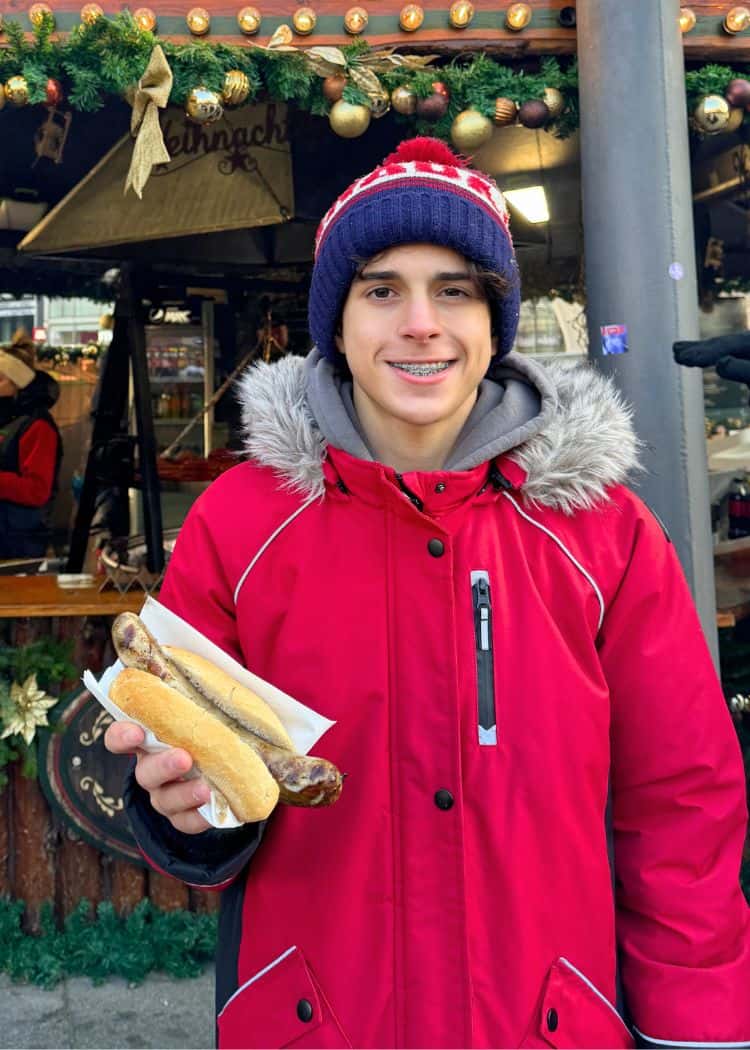
Since I am also of Italian heritage, this was a bit difficult. I have NEVER eaten pizza with a knife and fork! Ha!
13. Don’t Throw Out Pfand Bottles
In Germany, many bottles and cans come with a “Pfand,” which is a deposit you pay when purchasing beverages.
Instead of throwing these containers away, return them to a store or a reverse vending machine to get your deposit back.

This is a pretty great system that not only encourages recycling, but it helps reduce waste while putting a little bit of money back in your pocket!
14. Don’t Assume Credit Cards Are Accepted Everywhere
While credit cards are widely accepted in major cities and tourist areas, cash is still king in many parts of Germany.
Always carry some cash, especially when visiting smaller towns or local markets.

We found this to be the case when visiting Germany’s incredible Christmas Markets.
If you’re not sure, I would recommend that you ask if cards are accepted before making a purchase.
15. Don’t Talk Loudly on Public Transportation
Germans truly value quiet and privacy, especially in public spaces like trains and buses.
Speaking softly is appreciated. And loud conversations or phone calls that disturb others is considered extremely rude.

This is one cultural norm that I truly welcomed while in Germany!
Since we mostly relied on public transportation, it was nice not to have to listen to the loud phone conversations that are common in Toronto subways.
16. Don’t Forget to Validate Your Ticket
The majority of Germany’s public transportation runs on the honour system.
Trying to catch a ‘free ride’ is not only against the rules, but could end up costing you a pretty penny.
Instead, your tickets need to be validated either before boarding, or as soon as you get on the train/bus.
Look for validation machines at stations and stamp your ticket.

We usually stamped our tickets as we got on the train as the machines were right at the doors (notice the yellow box in the photo above).
And I can’t say it enough, fines for unvalidated tickets can be steep, even if you have purchased one.
We were checked by plainclothes transit controllers several times during our last visit.
17. Don’t Ignore Recycling Rules
Germany takes recycling very seriously, with strict rules for separating waste.
Familiarize yourself with the local recycling system, which often includes separate bins for paper, plastic, glass, and organic waste.

Even though we recycle at home, Germany’s system is a little more complex.
Luckily, the rental that we were staying in had detailed instructions for us, which made things so much easier.
18. Don’t Bring Up Sensitive Historical Topics
While it’s important to understand Germany’s history, discussing topics like World War II or the Nazi period can be sensitive.
Approach these subjects with respect and caution.

Most Germans, my family included, prefer to focus on the present and future rather than dwell on the past.
19. Be Respectful at Memorials
Germany is home to many memorials dedicated to significant and often sombre historical events.
When visiting these sites, it’s important to show respect.

You should avoid loud conversations and inappropriate behaviour. Even taking selfies is often frowned upon.
When the kids were younger, we made sure to talk to them about how their respectful behaviour helps to keep these places dignified and meaningful for everyone.
20. Don’t Dress Casually in Formal Settings
Germans often dress formally for certain occasions, including work, dining out, church, and social events.
Making sure that you are dressed appropriately for the occasion not only helps you to blend in a little better but also shows respect.

Our rule of thumb is that when in doubt, it’s better to be slightly overdressed than too casual.
21. Don’t Stare at Naked People
In Germany, public nudity, especially in saunas, spas, pools, and beaches is more common and culturally accepted.
Since you don’t normally see this in Canada, this was a little hard to get used to when I was visiting Germany as a child.

And it was definitely something that I gave my kids the heads-up about before we went swimming at a public pool!
And while there were more topless women (rather than completely nude folks), they were still given the whole speech about how staring is considered impolite!
things to Avoid in Germany – Final Thoughts
So there you have it, some of Germany’s most interesting cultural quirks and rules.
As someone who knows German culture well, I can tell you that following these tips will help you fit right in, and feel like a local in no time!
Showing respect and good behaviour goes a long way in Germany.
Pin This Post for Later!

Related Posts:
- Is There Uber in Germany? How to Get Around
- Best Things to Do in Hameln Germany with Kids
- 21 Things Not to Do in Germany – Expert Advice
- Ultimate Guide to Visiting the Ritter Sport Museum Waldenbuch
- Best German Foods: 40 Dishes You Need to Try
- What is the Legal Drinking Age in Germany?
- Best German Phrases for Travel (With FREE Printable)
