Best German Phrases for Travel (With FREE Printable)

Heading to Germany? Knowing a few basic German phrases can make your trip smoother and a lot more fun.
Even if most people speak English, I always find that the locals appreciate it when you try a few words in their language.
And since I already have a good working knowledge of German, it was up to John and the kids to learn a few important phrases (and me to just brush up).
On the upside, these phrases will also come in handy if you’re visiting Austria or parts of Switzerland, where German is also widely spoken. Bonus!
In this post, I will provide you with some easy German phrases that will help you greet people, order food, get directions, and handle everyday situations… You know, all the important stuff!
👉🏻 Don’t forget to grab your FREE printable cheat sheet at the bottom of this post!
Basic German Greetings and Politeness
While travelling through Germany, we found that English is pretty widely spoken and understood in most of the larger cities.
While Google Translate can help in a pinch, I really wanted the kids to learn a few basic phrases before our trip.

The list below is a great place to start.
It includes simple greetings, useful questions, and polite expressions that you’ll likely use every day.
We have included the words in English and German, as well as a phonetic pronunciation for each.
Good morning
• Guten Morgen
• (goo-ten mor-gen)
Good day / Hello
• Guten Tag
• (goo-ten tahk)
Good evening
• Guten Abend
• (goo-ten ah-bent)

Good night
• Gute Nacht
• (goo-te nahkt)
Goodbye
• Auf Wiedersehen
• (owf vee-der-zayn)
Bye (informal)
• Tschüss
• (chooss)
Thank you
• Danke
• (dahn-ke)
Thank you very much
• Vielen Dank
• (fee-len dahnk)

You’re welcome
• Bitte schön / Gern geschehen
• (bit-te shern / gairn geh-shayn)
Please
• Bitte
• (bit-te)
I’m sorry
• Es tut mir leid
• (es toot meer lite)
Excuse me / Pardon me
• Entschuldigung
• (ent-shool-dee-goong)

Useful Phrases for Getting Around Germany
Getting around in Germany is usually pretty easy, especially in the larger cities.
But in smaller towns or rural areas, signs might not always be in English, and directions can get a bit tricky.
Street names in Germany often change from one block to the next, and old city centers can have winding lanes that aren’t always well-marked.

If your phone loses signal or your GPS gets confused, don’t be shy about asking someone for help.
We found that most people were friendly, especially if you started with a polite greeting.
In fact, we had someone on the train come up and let us know that we were at the end of the line, and offer help getting our bags off, when we thought that the line went further.

The phrases below will help you ask for directions and find your way when you’re feeling turned around.
🗾 Expert Tip – Have the business card from your hotel handy. You can show the address to anyone, including cab drivers, if you are trying to find your way back. You can also do this with attraction addresses from Google Maps.
Where is…?
• Wo ist…?
• (voh ist)
How far is it?
• Wie weit ist es?
• (vee vite ist es)

Left
• Links
• (links)
Right
• Rechts
• (rekhts)
Straight ahead
• Geradeaus
• (geh-rah-de-ows)
Train station
• Bahnhof
• (bahn-hohf)
Subway / Metro
• U-Bahn
• (oo-bahn)

Tram
• Straßenbahn
• (shtrah-sen-bahn)
Which platform?
• Auf welchem Gleis?
• (owf vel-khem glyss)
Bus stop
• Bushaltestelle
• (boos-hal-te-shtel-le)
Taxi stand
• Taxistand
• (tak-see-shtahnd)
How do I get to…?
• Wie komme ich zu…?
• (vee kom-me ikh tsoo)

Helpful Everyday Phrases for Travel
Here are some basic, but important, phrases for when you are out and about in Germany.
At some point, I guarantee that you will use at least one of them. And if you have kids, asking for a restroom might be an everyday occurrence! 🤣🤣
Do you speak English?
• Sprechen Sie Englisch?
• (shprekh-en zee eng-lish)
I don’t understand
• Ich verstehe nicht
• (ikh fer-shtay-eh nikht)

Can you repeat that?
• Können Sie das wiederholen?
• (kur-nen zee dahs vee-der-ho-len)
Where is the restroom?
• Wo ist die Toilette?
• (voh ist dee toy-let-te)
Words to Know When Visiting Attractions
Germany is filled with amazing places to explore.
From castles and cathedrals to museums, parks, and historic squares, there’s so much to see and do.
The following words and phrases will definitely be helpful when you’re out sightseeing.
They will help you to read basic signs, ask questions, and generally make the most of your visit.

Museum
• Museum
• (moo-zay-um)
Gallery
• Galerie
• (gah-leh-ree-eh)
Church
• Kirche
• (keer-khe)
Castle
• Schloss
• (shloss)
Park
• Park
• (park)

Garden
• Garten
• (gar-ten)
Entrance
• Eingang
• (ine-gahng)
Exit
• Ausgang
• (ows-gahng)
Ticket
• Eintrittskarte
• (ine-tritts-kar-te)
Open
• Geöffnet
• (geh-urf-net)

Closed
• Geschlossen
• (geh-shloss-en)
Hours / Opening hours
• Öffnungszeiten
• (ur-fnoongs-tsy-ten)
Map
• Karte
• (kar-te)

German Words for Travelling with Kids
If you’re like us and would like to travel through Germany with kids, it helps to know a few child-related words.
It’s something most travellers don’t think about, until they’re in a new country with a little one who needs a bathroom or is begging to find a playground!

While we’re long past the stroller stage, the following words may help to make your travels with young children a little smoother.
Child
• Kind
• (kint)
Baby
• Baby
• (bay-bee)
Stroller
• Kinderwagen
• (kin-der-vah-gen)
Playground
• Spielplatz
• (shpeel-plah-ts)

Diaper
• Windel
• (vin-del)
Toy
• Spielzeug
• (shpeel-tsoyk)
Lost child
• Vermisstes Kind
• (fer-mis-tes kint)

Dining in Germany
We are a family of foodies. So going out for dinner and trying local specialties is a must wherever we go.
In our experience, ordering food in Germany is usually pretty easy.
Many places, especially in touristy areas or larger cities, tend to have English incorporated into their menus.

But in smaller towns or local spots, you might find that menus are only in German.
So, knowing a few basic phrases can make ordering simpler and definitely less stressful.
If you’re trying a new dish or have dietary needs (like John’s shellfish allergy), being able to ask politely or explain what you’d like can make all the difference.
A table for two, please
• Ein Tisch für zwei, bitte
• (ine tish fyoor tsvy bit-te)
Menu
• Speisekarte
• (shpy-ze-kar-te)
I would like…
• Ich hätte gern…
• (ikh het-te gairn)

Do you have…?
• Haben Sie…?
• (hah-ben zee)
Without…
• Ohne…
• (oh-neh)
With…
• Mit…
• (mit)
Water
• Wasser
• (vah-ser)
Tap water
• Leitungswasser
• (ly-toongs-vah-ser)

Beer
• Bier
• (beer)
Wine
• Wein
• (vine)
The check, please
• Die Rechnung, bitte
• (dee rekh-noong bit-te)
Fork
• Gabel
• (gah-bel)
Knife
• Messer
• (meh-ser)

Spoon
• Löffel
• (lef-fel)
I am vegetarian
• Ich bin Vegetarier (female: Vegetarierin)
• (ikh bin veh-geh-tah-ree-er / veh-geh-tah-ree-eh-rin)
I’m allergic to…
• Ich bin allergisch gegen…
• (ikh bin ah-lair-gish gay-gen)
Shopping in Germany
Germany is a great place to shop.
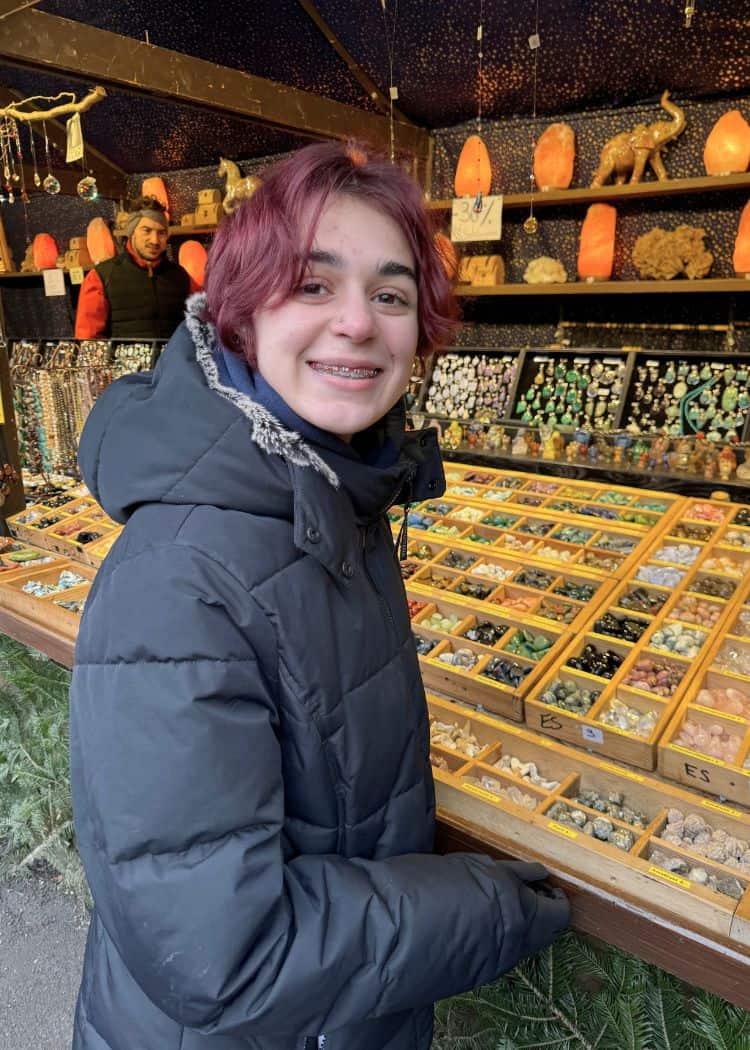
From department stores and Christmas markets to local bakeries and souvenir stands, you’ll find plenty to explore.
Whether you’re picking up something handmade or trying a local treat, a few key phrases will make the experience easier.

Let’s just say I’ve had to keep an eye on John more than once, as he can’t resist a good beer stein or German soccer gear!
These phrases will help you handle most shopping situations with confidence.
How much is this?
• Wie viel kostet das?
• (vee feel kohs-tet dahs)
Do you accept credit cards?
• Akzeptieren Sie Kreditkarten?
• (ahk-tsep-tee-ren zee kre-deet-kar-ten)
Can I have a receipt?
• Kann ich eine Quittung bekommen, bitte?
• (kahn ikh eye-neh kvit-toong beh-kom-men bit-te)
I’m just looking
• Ich schaue nur, danke
• (ikh shou-eh noor dahn-ke)
Do you have this in another size?
• Haben Sie das in einer anderen Größe?
• (hah-ben zee dahs in eye-ner ahn-de-ren groo-se)
Do you have this in another colour?
• Haben Sie das in einer anderen Farbe?
• (hah-ben zee dahs in eye-ner ahn-de-ren far-be)
That’s too expensive
• Das ist zu teuer
• (dahs ist tsoo toy-er)
Can I pay in cash?
• Kann ich bar bezahlen?
• (kahn ikh bar beh-tsah-len)

Asking for Help in Germany
When you’re in another country, needing help can feel stressful, especially if there’s a language barrier.
While we were lucky not to have any emergencies, it’s always good to know a few key phrases just in case.

These words can be important if you’re sick, injured, or need urgent help.
Help!
• Hilfe!
• (hil-fe)
Call the police!
• Rufen Sie die Polizei!
• (roo-fen zee dee poh-lee-tsai)
Call an ambulance!
• Rufen Sie einen Krankenwagen!
• (roo-fen zee eye-nen kran-ken-vah-gen)
I’m sick
• Ich bin krank
• (ikh bin krangk)

I need a doctor
• Ich brauche einen Arzt
• (ikh brow-khe eye-nen artst)
Where is the hospital?
• Wo ist das Krankenhaus?
• (voh ist dahs kran-ken-hows)
Is there a pharmacy nearby?
• Gibt es eine Apotheke in der Nähe?
• (gibt es eye-neh ah-poh-tay-ke in der nay-eh)

Basic Numbers in German
Many travellers don’t think to learn how to say numbers when studying a new language.
But let me tell you, it really comes in handy when you are out shopping and reading prices, or for telling time, booking tickets, or giving directions.

The kids made sure to memorize at least the numbers 1 through 10.
This definitely helped them when ordering snacks while out sightseeing, or asking for pretzels and hot chocolate at the Christmas markets.
1
• eins
• (ines)
2
• zwei
• (tsvy)
3
• drei
• (dry)
4
• vier
• (feer)
5
• fünf
• (foonf)

6
• sechs
• (zeks)
7
• sieben
• (zee-ben)
8
• acht
• (ahkt)
9
• neun
• (noyn)
10
• zehn
• (tsayn)

Larger numbers are also useful, especially when reading prices, exchanging money, or understanding train schedules.
50
• fünfzig
• (foonf-tsikh)
100
• hundert
• (hoon-dert)
500
• fünfhundert
• (foonf-hoon-dert)

1,000
• tausend
• (tow-zent)
5,000
• fünftausend
• (foonf-tow-zent)
10,000
• zehntausend
• (tsayn-tow-zent)

Telling the Time in German
Telling time might not seem like the most important thing to learn, but it can be really helpful when you’re travelling.
Whether you’re checking train schedules, joining a walking tour, or planning to visit a museum or restaurant, knowing how to ask and understand the time makes things much easier.
We didn’t use these phrases too often, but it’s still handy to know a few time-related words while you’re in Germany.

What time is it?
• Wie spät ist es?
• (vee shpayt ist es)
Time
• Zeit
• (tsyte)
Hour
• Stunde
• (shtoon-de)
Minute
• Minute
• (mee-noo-te)
Morning
• Morgen
• (mor-gen)

Afternoon
• Nachmittag
• (nahkh-mit-tahk)
Evening
• Abend
• (ah-bent)
Now
• Jetzt
• (yetst)
Open at…
• Öffnet um…
• (urf-net oom)
Closes at…
• Schließt um…
• (shleest oom)

Days of the Week in German
Just like telling time, knowing the days of the week is surprisingly useful when you’re travelling.
Whether you’re checking a train schedule, booking a tour, or figuring out which days shops, museums, or restaurants are open, it helps to know what day it is.
This is especially true since not everything operates daily in Germany.

Monday
• Montag
• (mohn-tahk)
Tuesday
• Dienstag
• (deens-tahk)
Wednesday
• Mittwoch
• (mit-vokh)
Thursday
• Donnerstag
• (don-er-stahk)

Friday
• Freitag
• (fry-tahk)
Saturday
• Samstag / Sonnabend
• (zahm-stahk / zon-ah-bent)
Sunday
• Sonntag
• (zon-tahk)
Tips for Learning German Phrases
Here are a few tips and tricks that John and the kids used to learn some German before our trip:

Use Flashcards
Flashcards are perfect for memorizing basic German words, especially for kids.
Brands like Berlitz and Usborne have great flashcard sets, and pairing them with workbooks or games keeps things fun and engaging.

We used flashcards a lot when the kids were younger and starting to learn new languages.
It made practice time something they actually looked forward to.
Read the German Phrases Out Loud
I always find it helpful to read the phrases out loud.
Working through this guide aloud helps with pronunciation and builds confidence when speaking.

I’ll admit, I sometimes struggle to actually use the phrases I’ve memorized when I’m face-to-face with someone!
Repeating each phrase several times helps you get comfortable with the sound and rhythm of the words.
📖 Expert Tip – Pick up some children’s basic vocabulary books or early readers to help learn a few more words. You can find a treasure trove of them online or even borrow them from your local library.
Use a Language App
Language apps are great for practicing German on the go.
My younger daughter has her own Duolingo account and loves keeping up her streak.

These apps have interactive lessons, quick quizzes, and pronunciation practice, which are perfect for squeezing in learning time during busy days.
Listen to German Podcasts, Radio, or Television
Listening to native speakers helps you get used to the pace and flow of the language.
You can try German podcasts, radio stations, or even watch TV shows and YouTube videos.

While I didn’t use this method for learning Japanese, I found it super helpful when brushing up on my German.
This was especially the case when picking up everyday expressions and phrases that I had never heard before.
📺 Fun fact: My Italian grandmother learned English by watching soap operas on TV!
Practice with a Native Speaker
Nothing beats practicing with someone who actually speaks the language.
Conversations with locals can really boost your confidence and help you improve quickly.

My mom is the only native speaker that I could practice with before our trip, but once we arrived, we tried to use our phrases as much as possible.
Even small interactions, like ordering food or asking for directions, make a big difference.
Final Thoughts
You don’t need to be fluent to enjoy travelling in Germany.
Even learning a handful of basic phrases can make your trip smoother and more enjoyable.
It shows effort, helps you connect with locals, and can turn a simple exchange, like ordering food or buying tickets, into a genuine moment of connection.
We tried to use our German as often as possible, even if it wasn’t perfect. Most people appreciated the effort and were quick to help us along.
If you’re planning a trip soon, take a little time to practice — it really does make a difference.
☝🏻 Don’t forget to download your FREE German Phrases for Travel printable!
Pin This Post for Later!

Related posts:
- Is There Uber in Germany? How to Get Around
- Best Things to Do in Hameln Germany with Kids
- 21 Things Not to Do in Germany – Expert Advice
- Ultimate Guide to Visiting the Ritter Sport Museum Waldenbuch
- Best German Foods: 40 Dishes You Need to Try
- What is the Legal Drinking Age in Germany?
- Best German Phrases for Travel (With FREE Printable)
