Best Italian Phrases for Travel (With FREE Printable)

Looking for the best Italian phrases for travel? Well, you have come to the right place!
It’s always good to learn some important phrases when travelling to a new country. It not only shows respect, but trust me when I say, locals will treat you better if you are at least attempting to speak their language!
Both John and I were raised in Italian-speaking families and have been to Italy several times. So we absolutely know what we are talking about.
Hubby is completely fluent. However, I could definitely use some brushing up. So, I can speak from experience when I say that it is important to learn at least the basics.
So we have put together a list of the most important, and most used phrases that you will need to know before travelling to Italy.
Essential Italian Phrases
Unlike many places in Europe, there aren’t a lot of people who speak English in some parts of Italy.
As such, I would have struggled to communicate, if not for learning at least a few basic phrases.

These phrases should give you a great starting point for communicating in Italian.
They cover basic greetings, essential questions, and polite expressions that are useful in everyday interactions.
Good morning
Buongiorno (bwon-jor-no)
Good evening
Buonasera (bwon-ah-seh-rah)
Please
Per favore (pehr fah-voh-reh)
Thank you
Grazie (grah-tsee-eh)
Excuse me (to get someone’s attention)
Mi scusi (mee skoo-zee)
Excuse me (to navigate through)
Permesso (per-mess-so)
Where is the bathroom?
Dove il bagno? (doh-veh eel bahn-yo)
How much does it cost?
Quanto costa? (kwahn-toh koh-stah)
Do you speak English?
Parla inglese? (par-lah een-gleh-zeh)
Can I have the menu?
Posso avere il menu? (pohs-soh ah-veh-reh eel meh-noo)
A ticket to [destination], please
Un biglietto per [destination], per favore (oon beel-yet-toh pehr [destination], pehr fah-voh-reh)
I don’t understand
Non capisco (nohn kah-pees-koh)
Can you help me?
Può aiutarmi? (pwaw ah-yoo-tar-mee)
Common Greetings in Italian
This list covers a range of common Italian greetings that you can use in various social contexts, from casual to formal.

From meeting new friends to addressing a tour guide, or meeting up with family, the following greetings are perfect for getting started with basic Italian communication.
Hello / Hi
Ciao (chow)
Good morning
Buongiorno (bwon-jor-no)
Good afternoon
Buon pomeriggio (bwon po-meh-ree-joh)
Good evening
Buonasera (bwon-ah-seh-rah)
Good night
Buonanotte (bwon-ah-not-teh)
See you later
A dopo (ah doh-poh)
See you soon
A presto (ah preh-stoh)
Goodbye (formal)
Arrivederci (ah-ree-veh-der-chee)
Goodbye (informal)
Ciao (chow)
Nice to meet you
Piacere (pyah-cheh-reh)
How are you? (formal)
Come sta? (coh-meh stah)
How are you? (informal)
Come stai? (coh-meh sty)
I’m fine, thanks. And you?
Sto bene, grazie. E tu? (stoh beh-neh, grah-tsee-eh. eh too?)
Making Small Talk in Italian
Making small talk is a great way for you to immerse yourself in the local culture.

From talking to a store clerk to exchanging pleasantries with someone I met while eating gelato in the local park, being friendly was a great way to practice my language skills while on vacation.
How are you? (formal)
Come sta? (coh-meh stah)
How are you? (informal)
Come stai? (coh-meh sty)
My name is [your name]. And you?
Mi chiamo [your name]. E tu? (mee kyah-moh [your name]. eh too?)
Where are you from?
Di dove sei? (dee doh-veh seh-ee)
The weather is nice today.
Il tempo è bello oggi. (eel tem-poh eh bel-loh oh-jee)
I like Italy.
Mi piace l’Italia. (mee pee-ah-cheh l’ee-tal-ya)
What is your favorite Italian food?
Quale è il tuo cibo italiano preferito? (kwah-leh eh eel too-oh chee-boh ee-tal-ee-ah-no preh-feh-ree-toh)
Do you have any recommendations on places to visit?
Hai qualche consiglio su posti da visitare? (eye kwal-keh kohn-seel-yoh soo poh-stee dah vee-see-tah-reh)
I visited [place] and I liked it a lot.
Ho visitato [place] e mi è piaciuto molto. (oh vee-zee-tah-toh [place] eh mee eh pee-ah-choo-toh mohl-toh)
Hope to see you again soon!
Spero di rivederti presto! (speh-roh dee ree-veh-dehr-tee preh-stoh)
Asking for Directions in Italian
Some Italian cities and small towns are like a maze! And with a poor signal on your phone, you may need to ask for directions.

I can’t even tell you how many times we got turned around when walking the small alleyways in Venice!
Anyway, these phrases will assist you in finding your way around Italy.
Where is [place]?
Dove si trova [place]? (doh-veh see troh-vah [place])
Can you tell me how to get to [place]?
Mi può dire come arrivare a [place]? (mee pwoh dee-reh koh-meh ah-ree-vah-reh ah [place])
Is it far from here?
È lontano da qui? (eh lon-tah-no dah kwee)
Can I walk there?
Posso andare a piedi? (pohs-soh an-dah-reh ah pee-eh-dee)
Which bus should I take for [place]?
Quale autobus devo prendere per [place]? (kwah-leh ow-toh-boos deh-voh pren-deh-reh pehr [place])
Where is the train station?
Dove si trova la stazione ferroviaria? (doh-veh see troh-vah lah stah-tsee-oh-neh fehr-roh-vyah-ree-ah)
Where can I find a taxi?
Dove posso trovare un taxi? (doh-veh pohs-soh troh-vah-reh oon tahk-see)
Does this road go to [place]?
Questa strada va a [place]? (kweh-stah strah-dah vah ah [place])
What time does the bus come?
A che ora passa l’autobus? (ah keh oh-rah pahs-sah low-toh-boos)
How do I get back to [your hotel/street]?
Come faccio a tornare a [your hotel/street]? (koh-meh fah-cho ah tor-nah-reh ah [your hotel/street])
Is this the right way to [place]?
È questa la direzione giusta per [place]? (eh kweh-stah lah dee-rek-tsee-oh-neh joo-stah pehr [place])
Excuse me, I’m lost. Can you help me?
Scusi, sono perso/a. Mi può aiutare? (skoo-zee, soh-noh pehr-soh/ah. mee pwoh ah-yoo-tah-reh)
Italian Question Words
I was always taught that asking questions is the best way to learn. This also applies when you are trying to navigate around a new place.
These question words form the basis of many essential inquiries and will be incredibly useful as you travel around Italian-speaking regions.

With these words, you can ask about places, times, people, and reasons, making your travel experience a little less stressful.
Who?
Chi? (kee)
What?
Che cosa? / Cosa? (keh koh-sah / koh-sah)
Where?
Dove? (doh-veh)
When?
Quando? (kwahn-doh)
Why?
Perché? (pehr-keh)
How?
Come? (koh-meh)
Which? / Which ones?
Quale? / Quali? (kwah-leh / kwah-lee)
How much? / How many? (masculine)
Quanto? (kwahn-toh)
How much? / How many? (feminine)
Quanta? (kwahn-tah)
How many? (masculine plural)
Quanti? (kwahn-tee)
How many? (feminine plural)
Quante? (kwahn-teh)
Useful Phrases at Restaurants
Good food is definitely synonymous with Italy. And trust me when I say, we didn’t hesitate to dive right in!
From seafood to pasta, gelato to cannoli, we tried it all.
However, since both John and I suffer from food allergies (he has a bad shellfish allergy), it was really important that we were able to confirm the ingredients in many of the new dishes we tried.

So, these phrases will really come in handy when you’re dining out in Italy.
It’ll help you order food, ask about dishes, and express your dietary preferences or restrictions. Buon appetito!
A table for [number of people], please.
Un tavolo per [number of people], per favore. (oon tah-voh-loh pehr [number], pehr fah-voh-reh)
The menu, please.
Il menu, per favore. (eel meh-noo, pehr fah-voh-reh)
What do you recommend?
Cosa consiglia? (koh-sah kohn-see-lyah)
I am allergic to [allergen].
Sono allergico/a a [allergen]. (soh-noh al-ler-jee-koh/ah ah [allergen])
Dairy / Gluten / Fish
Latticini / Glutine / Pesce. (laht-tee-chee-nee / gloo-tee-neh / peh-she)
I am vegetarian
Sono vegetariano/a. (so-no veh-je-ta-ree-ah-no/na)
Can I have the bill?
Posso avere il conto? (pohs-soh ah-veh-reh eel kohn-toh)
Can I pay by card?
Posso pagare con la carta? (pohs-so pah-gah-re kon lah kahr-ta)
Still/sparkling water, please.
Acqua naturale/frizzante, per favore. (ahk-wah nah-too-rah-leh/free-zahn-teh, pehr fah-voh-reh)
Can I taste the wine?
Posso assaggiare il vino? (pohs-soh ah-sah-jyah-reh eel vee-noh)
I would like [dish], please.
Vorrei [dish], per favore. (vohr-ray [dish], pehr fah-voh-reh)
How is this dish prepared?
Come è preparato questo piatto? (koh-meh eh preh-pah-rah-toh kweh-stoh pee-ah-toh)
Is it spicy?
È piccante? (eh pee-kan-teh)
Could I have more [ingredient/utensil]?
Potrei avere più [ingredient/utensil]? (poh-treh-ee ah-veh-reh pee-oo [ingredient/utensil])
Thank you, it was delicious!
Grazie, è stato delizioso! (grah-tsee-eh, eh stah-toh deh-lee-tsyoh-zoh)
Where’s the bathroom?
Dov’è il bagno? (doh-veh eel bah-nyoh)
Shopping Words in Italian
When in Rome or Milan, you will want to shop! From incredible leather shoes to designer clothes, purses, and cologne, you will be tempted at every turn!
I practically had to put blinders on Hubby! Ha!
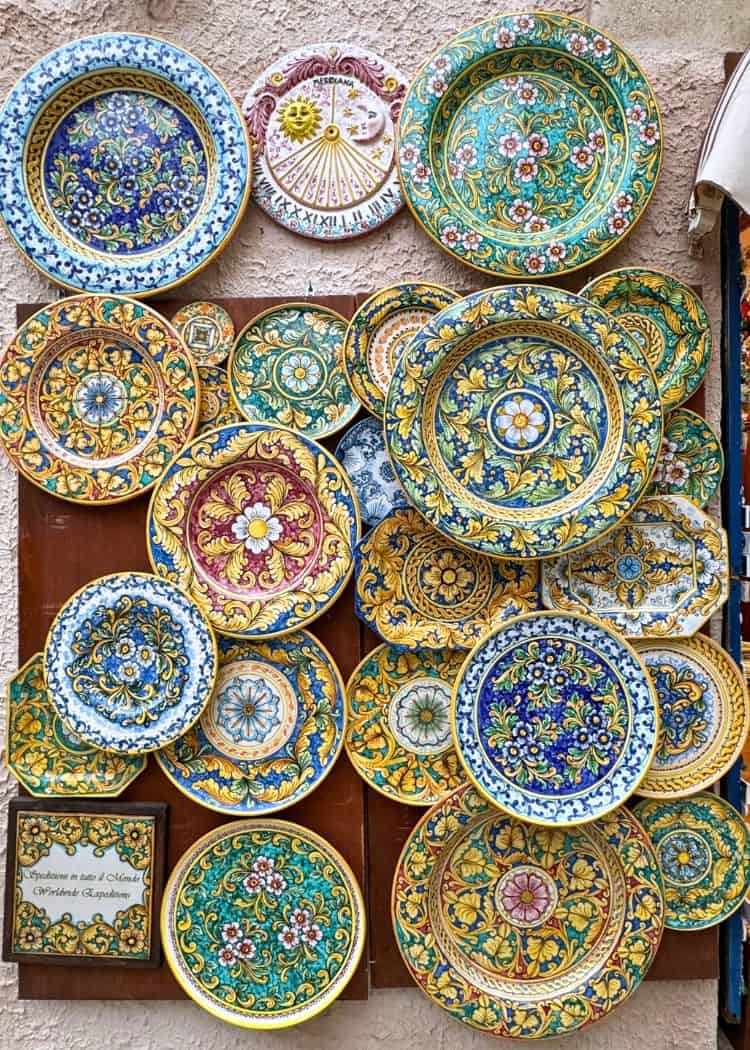
This list will be pretty helpful for you when you go shopping in Italy. It will give you the basic vocabulary needed for a smooth shopping experience.
Shop / Store
Negozio (neh-go-tsyoh)
Market
Mercato (mehr-kah-toh)
Supermarket
Supermercato (soo-pehr-mehr-kah-toh)
Shopping
Shopping (shohp-ping)
Price
Prezzo (pret-tsoh)
Sale
Saldi (sal-dee)
Discount
Sconto (skohn-toh)
Cash
Contanti (kohn-tahn-tee)
Credit card
Carta di credito (kar-tah dee kreh-dee-toh)
Receipt
Scontrino (skohn-tree-no)
Size
Taglia (tah-lyah)
Large
Grande (grahn-deh)
Medium
Medio (meh-dyoh)
Small
Piccolo (peek-koh-loh)
Fitting room
Camerino (kah-meh-ree-noh)
Open
Aperto (ah-pehr-toh)
Closed
Chiuso (kyoo-soh)
Entrance
Entrata (ehn-trah-tah)
Exit
Uscita (ooh-shee-tah)
How much is this?
Quanto costa questo? (kwahn-toh koh-stah kweh-stoh)
Can I pay with a credit card?
Posso pagare con la carta di credito? (pohs-soh pah-gah-reh kohn lah kar-tah dee kreh-dee-toh)
Words to Know When You Are Visiting Attractions
Italy is an absolutely gorgeous place to visit.
With amazing architecture, jaw-dropping landscapes, and interesting attractions, you will have a difficult time deciding where to go first.

These words and phrases will be very useful when you explore various attractions in Italy. They will help you to navigate and enjoy your experiences to the fullest.
Ticket
Biglietto (bee-lyet-toh)
Entrance
Entrata (ehn-trah-tah)
Exit
Uscita (ooh-shee-tah)
Opening hours
Orario di apertura (oh-rah-ryo dee ah-per-too-rah)
Closing hours
Orario di chiusura (oh-rah-ryo dee kyoo-soo-rah)
Guide
Guida (gwee-dah)
Tour
Tour (toor)
Map
Mappa (mah-pah)
Information
Informazioni (een-for-mah-tsyoh-nee)
Audio guide
Audioguida (ow-dee-oh-gwee-dah)
Museum
Museo (moo-seh-oh)
Gallery
Galleria (gahl-leh-ree-ah)
Church
Chiesa (kyeh-sah)
Restroom / Bathroom
Bagno (bahn-yo)
Do not touch
Non toccare (nohn tok-kah-reh)
Photography allowed
Fotografia permessa (foh-toh-grah-fee-ah pehr-mehs-sah)
No photography
Vietato fotografare (vyeh-tah-toh foh-toh-grah-fah-reh)
Gift shop
Negozio di souvenir (neh-go-tsyoh dee soo-veh-neer)
Where is the [attraction]?
Dove si trova [attraction]? (doh-veh see troh-vah [attraction])
Is there a guided tour?
C’è un tour guidato? (cheh oon toor gwee-dah-toh)
Kids-Related Phrases in Italian
If like us, you are planning to visit Italy with kids in tow, then you may be interested in learning some child-specific vocabulary.

Most travellers don’t give this a second thought (us included) until they are in a foreign country with kids and don’t know the word for “diapers” or “playground”!
Where is the playground?
Dove si trova il parco giochi? (doh-veh see troh-vah eel par-koh joh-kee)
I have a child/children.
Ho un bambino/bambini. (oh oon bam-bee-no/bam-bee-nee)
Can my child try this?
Mio figlio può provare questo? (mee-oh fee-lyoh pwoh proh-vah-reh kweh-stoh)
Is there a children’s menu?
C’è un menu per bambini? (cheh oon meh-noo pehr bam-bee-nee)
We need a high chair.
Abbiamo bisogno di una seggiolone. (ahb-byah-moh bee-zoh-nyoh dee oo-nah sej-joh-loh-neh)
Where is the nearest bathroom?
Dove è il bagno più vicino? (doh-veh eh eel bahn-yo pyoo vee-chee-noh)
Is this place child-friendly?
Questo posto è adatto ai bambini? (kweh-stoh poh-stoh eh ah-dah-toh eye bam-bee-nee)
My child is allergic to [allergen].
Mio figlio è allergico a [allergen]. (mee-oh fee-lyoh eh al-ler-jee-koh ah [allergen])
Can we get a discount for children?
Possiamo avere uno sconto per bambini? (pohs-syah-moh ah-veh-reh oo-noh skohn-toh pehr bam-bee-nee)
Do you have any activities for children?
Avete attività per bambini? (ah-veh-teh at-tee-vi-tah pehr bam-bee-nee)
We need a baby cot/crib.
Abbiamo bisogno di una culla. (ahb-byah-moh bee-zoh-nyoh dee oo-nah cool-lah)
Where can I change my baby’s diapers??
Dove posso cambiare i pannolini del mio bambino? (doh-veh pohs-soh cahm-byah-reh ee pahn-noh-lee-nee del mee-oh bam-bee-noh)
Where can I find diapers?
Dove posso trovare i pannolini? (doh-veh pohs-soh troh-vah-reh ee pahn-noh-lee-nee)
Asking for Help in Italian
Sometimes things don’t always go our way when we travel. Whether it’s getting lost, or worse, getting sick or hurt.
In cases like this, it’s always a good idea to at least know how to ask for help.

This list will be very helpful if you ever need assistance in Italy. It covers a range of situations where asking for help is necessary.
Can you help me?
Mi può aiutare? (mee pwoh ah-yoo-tah-reh)
I need help.
Ho bisogno di aiuto. (oh bee-zoh-nyoh dee ah-yoo-toh)
I’m lost.
Mi sono perso/a. (mee soh-noh pehr-soh/ah)
Can you call a doctor?
Può chiamare un medico? (pwoh kyah-mah-reh oon meh-dee-koh)
Where is the nearest hospital?
Dove è l’ospedale più vicino? (doh-veh eh los-peh-dah-leh pyoo vee-chee-noh)
I need a pharmacy.
Ho bisogno di una farmacia. (oh bee-zoh-nyoh dee oo-nah fahr-mah-chyah)
Can you call the police?
Può chiamare la polizia? (pwoh kyah-mah-reh lah poh-lee-tsyah)
Is there someone here who speaks English?
C’è qualcuno qui che parla inglese? (cheh kwahl-koo-noh kwee keh par-lah een-gleh-zeh)
I need a taxi.
Ho bisogno di un taxi. (oh bee-zoh-nyoh dee oon tahk-see)
I lost my bag/wallet.
Ho perso la mia borsa/il mio portafoglio. (oh pehr-soh lah mee-ah bor-sah/eel mee-oh por-tah-foh-lyoh)
Can you show me on the map?
Può mostrarmi sulla mappa? (pwoh moh-strahr-mee sool-lah mah-pah)
I don’t understand.
Non capisco. (nohn kah-pees-koh)
How to Say Numbers in Italian
This list covers the basic numbers which can be important in a variety of situations like shopping, telling time, booking tickets, or even giving directions.

I’m telling you, the below chart will come in very handy during your travels in Italy!
| Number | Italian | Number | Italian |
|---|---|---|---|
| 1 | Uno (oo-noh) | 11 | Undici (oon-dee-chee) |
| 2 | Due (doo-eh) | 12 | Dodici (doh-dee-chee) |
| 3 | Tre (treh) | 13 | Tredici (treh-dee-chee) |
| 4 | Quattro (kwah-troh) | 14 | Quattordici (kwah-tor-dee-chee) |
| 5 | Cinque (cheen-kweh) | 15 | Quindici (kween-dee-chee) |
| 6 | Sei (say) | 16 | Sedici (seh-dee-chee) |
| 7 | Sette (seh-teh) | 17 | Diciassette (dee-chahs-seh-teh) |
| 8 | Otto (oht-toh) | 18 | Diciotto (dee-choht-toh) |
| 9 | Nove (noh-veh) | 19 | Diciannove (dee-chah-noh-veh) |
| 10 | Dieci (dyeh-chee) | 20 | Venti (vehn-tee) |
| Number | Italian |
|---|---|
| 30 | Trenta (tren-tah) |
| 40 | Quaranta (kwah-ran-tah) |
| 50 | Cinquanta (cheen-kwan-tah) |
| 60 | Sessanta (ses-san-tah) |
| 70 | Settanta (seh-tan-tah) |
| 80 | Ottanta (oht-tan-tah) |
| 90 | Novanta (noh-van-tah) |
| 100 | Cento (chen-toh) |
| 1000 | Mille (meel-leh) |
Telling the Time in Italian
Many people don’t consider learning how to tell time in another language to be very important. But it is!

If you need to ask someone about the bus or train schedule, when to meet up with a tour group, or when an attraction or restaurant opens or closes, you will need to know the basics.
What time is it?
Che ore sono? (keh oh-reh soh-no)
It’s 1 o’clock.
È l’una. (eh loo-nah)
It’s 2 o’clock.
Sono le due. (soh-no leh doo-eh)
It’s 3:15.
Sono le tre e un quarto. (soh-no leh treh eh oon kwar-toh)
It’s 4:30.
Sono le quattro e mezza. (soh-no leh kwah-troh eh met-tsah)
It’s 5:45.
Sono le cinque meno un quarto. (soh-no leh cheen-kweh meh-no oon kwar-toh)
It’s noon.
È mezzogiorno. (eh met-zoh-jor-no)
It’s midnight.
È mezzanotte. (eh met-za-not-teh)
AM (in the morning)
Di mattina (dee mah-tee-nah)
PM (in the afternoon/evening)
Di pomeriggio / Di sera (dee po-meh-ree-joh / dee seh-rah)
Days of the Week in Italian
Learning the days of the week is just as important as learning to tell time and for exactly the same reasons.

Whether you are checking the bus or train schedule, or wondering what days an attraction is open or closed, know these Italian words will come in pretty handy.
Monday
Lunedì (loo-neh-dee)
Tuesday
Martedì (mar-teh-dee)
Wednesday
Mercoledì (mer-koh-leh-dee)
Thursday
Giovedì (joh-veh-dee)
Friday
Venerdì (veh-neh-dee)
Saturday
Sabato (sah-bah-toh)
Sunday
Domenica (do-men-ee-kah)
Useful Words for Transport and Getting Around
Unless you are travelling on a guided tour (which we have also done), learning some words and phrases related to transportation and getting around while in Italy is one of my important travel tips.

The below phrases cover various modes of transport, directions, and general terms that are useful in travel.
Train
Treno (treh-noh)
Bus
Autobus (ow-toh-boos)
Tram
Tram (trahm)
Subway / Metro
Metropolitana (meh-troh-poh-lee-tah-nah)
Taxi
Taxi (tahk-see)
Airport
Aeroporto (ah-eh-roh-por-toh)
Station
Stazione (stah-tsyoh-neh)
Ticket
Biglietto (bee-lyet-toh)
Timetable
Orario (oh-rah-ryoh)
Platform
Binario (bee-nah-ryoh)
Car rental
Noleggio auto (noh-leh-joh ow-toh)
Bicycle
Bicicletta (bee-chee-klet-tah)
Road
Strada (strah-dah)
Highway
Autostrada (ow-toh-strah-dah)
Traffic
Traffico (trahf-fee-koh)
Direction
Direzione (dee-rek-tsyoh-neh)
Map
Mappa (mah-pah)
Left
Sinistra (see-nee-strah)
Right
Destra (deh-strah)
Straight ahead
Dritto (dreet-toh)
Roundabout
Rotonda (roh-ton-dah)
Stop (on a sign)
Stop (stop)
Crosswalk
Attraversamento pedonale (ah-trah-ver-sah-men-toh peh-doh-nah-leh)
Where is the nearest…?
Dove si trova il/la più vicino/a…? (doh-veh see troh-vah eel/la pyoo vee-chee-noh/ah)
Tips for Learning Italian Phrases
The following are some tips and tricks that the kids and I used to learn some Italian before our trip to Sicily:
1. Read the Italian Travel Phrases We Provided Out Loud
When I’m trying to learn Italian phrases, I always find it helpful to read them out loud. Try to work your way through our post (or use the free cheat sheet) to start out.
I found that this not only helped with pronunciation but also boosted my confidence in speaking (which is my biggest problem).

I make it a point to repeat each phrase several times, focusing on the nuances of how each word sounds. It’s a great way to get a feel for the rhythm and melody of the language.
Not to mention, it’s a fun way to practice, especially when you start getting the hang of rolling those Rs!
2. Use a Language App. to Practice
I highly recommend using a language app to practice Italian. It’s a convenient way to learn common Italian phrases, especially when I’m on the go.
Our younger daughter, Miss Somersault, has her own Duolingo account which she uses daily to practice her language skills.
These apps often come with interactive lessons, quizzes, and sometimes even games, which make learning less of a chore and more of an engaging activity.

Whether it’s during a coffee break or while waiting to pick the kids up at school, I squeeze in a quick lesson.
It’s amazing how much progress you can make with just a few minutes of daily practice.
3. Listen to Italian Podcasts, Radio, or Television
Immersing myself in the language is key, and what better way than listening to Italian podcasts, radio, or watching Italian TV shows?
This approach helps me get accustomed to the speed and flow of the language as it’s spoken by natives.
I usually don’t understand everything, but it’s about getting my ears used to the sounds and rhythms.

Plus, it’s a great way to pick up on cultural nuances and contemporary usage that textbooks might not cover.
I learned this technique from my Nonna, who learned English from watching Soap Operas on TV! It is a little difficult at first, but if you are also using the above tips, it will get easier.
4. Practice with a Native Speaker
There’s no substitute for practicing with a native Italian speaker. This is where John came in! He was our family’s go-to language partner!
Honestly, I still found it to be a bit intimidating at first. But it’s incredibly effective.

Conversing with a native speaker can challenge you to use what you’ve learned in real-life situations. This helps you to become fluent faster.
Plus, when practicing with a native speaker, they can offer instant feedback and tips on pronunciation and colloquialisms that you wouldn’t learn otherwise.
5. Use Flashcards
Flashcards are my go-to for helping the kids memorize basic Italian words. They’re simple, versatile, and incredibly effective.
Our youngest son, Mr. Bump, found this to be the easiest way to learn some vocabulary quickly.

Both Berlitz and Usborne make awesome sets of flashcards. They are also perfect for younger children (Mr. Bump was 9 the first time we went to Italy).
Flashcards can also be paired with workbooks or even colouring books for younger kids. They make learning a new language more like a game and less like a chore.
Italian Phrases for Travel – FAQs

With regular practice, you can learn basic Italian phrases in a few weeks. Consistency is key, so even dedicating a few minutes daily can make a big difference.
While it’s not necessary, speaking some Italian will make things easier during your travels. It also shows respect for the local culture and helps in better connecting with locals.
Using language learning apps, listening to Italian music, podcasts, and practicing speaking with native speakers or language exchange partners are effective methods.
Italians generally appreciate the effort and are quite patient and encouraging with travellers trying to speak their language.
Good pronunciation helps in being better understood. However, Italians are usually forgiving of mistakes and can often understand you from the context.
Basic Italian is sufficient for most travellers. Regional dialects vary, but standard Italian is widely understood and spoken throughout the country.
In major cities and tourist areas, many people speak English, especially in hotels, restaurants, and popular attractions. However, knowing Italian is beneficial in less touristy areas.
Italians value politeness, so always use “please” (per favore) and “thank you” (grazie). Also, be mindful of using the formal “Lei” in polite or formal situations.
It’s okay! You can always use gestures, or most Italians will try to help you out, especially if they see you’re making an effort. Carrying a phrasebook or a translation app can also be handy.
Download Our FREE Printable!
We have put together a cheat sheet of the best Italian phrases for travel.
Final Thoughts on Useful Italian Phrases for Travel
Wrapping up, I really hope you’ve found this guide handy. It’s amazing how just a few phrases can transform your travel experience.
Speaking the local language, even just a little, can open so many doors. And don’t worry about getting every word perfect – it’s the effort that counts.
Besides, Italians are known for their warmth and hospitality, and they’ll appreciate your attempts to speak their language.
Plus, it’s a great icebreaker and can lead to some of the most memorable moments of your trip. So, go ahead and give these phrases a shot.
Happy travels! Or Buon viaggio!
Pin This Post for Later!

Related Posts:
- Best Italian Phrases For Travel (With FREE Printable)
- 37 Best Souvenirs from Italy to Take Home
- What Not To Do In Italy – 21 Things To Avoid As A Tourist
- 17 Best Christmas Traditions in Italy: From Food to Festivities
- What is the Legal Drinking Age in Italy?
